
Business casual sneakers are now standard in most offices, which has quietly created a new problem: the dress code says sneakers are fine, and nobody tells you which ones. The pair that works with wool trousers and the pair you run in are different objects built for different jobs, and wearing the wrong one is more conspicuous than wearing no sneakers at all. This guide covers which sneakers actually pass as business casual, how to judge one before you buy it, and how to build the rest of the outfit around it.
Are Sneakers Business Casual?
Usually yes, with a narrow definition of sneaker. Business casual asks for clothing that reads considered rather than athletic, so the test is not whether an item is technically a sneaker but whether it looks like sports equipment. A plain leather low top in white, grey, or black sits comfortably inside the code at most companies. A running shoe with a visible air unit and a mesh upper does not, no matter how new it is.
Two situations override this. If your office states “business professional” rather than business casual, wear leather soles. And on days you are meeting clients, interviewing, or presenting to people who have never met you, default up rather than down.
What Separates an Office Sneaker From a Running Shoe
Four things decide it: the silhouette, the material, the sole, and the amount of visible branding and hardware.

Silhouette comes first. You want a low top with a slim sole and a toe that does not flare. Chunky midsoles, pronounced heel counters, and the aggressive geometry of a performance running shoe all read as athletic no matter what you wear them with, because the shape itself is the signal.
Material is the next lever. Smooth full-grain leather is the dressiest option and the one that can sit beside a sport coat without apology. Suede is a close second and reads warmer, which suits autumn and winter. Canvas is firmly casual, good with denim at the weekend, and out of place with wool trousers on a Tuesday.
Soles should be thin and quiet in color. White rubber is the default and works with almost everything. Gum soles add warmth and pair naturally with tan and olive. Thick white foam, air units, and heavy tread belong on a different kind of shoe.
Finally, the less branding the better. Large logos, contrast swooshes, and reflective panels pull the eye straight to your feet. A plain upper lets the sneaker do its job, which is to lower the formality of an outfit by one notch without becoming the subject of it.
How They Should Fit
Sneakers run roomier than dress shoes, and people take advantage of that in the wrong direction. You want about a thumb’s width between your longest toe and the end of the shoe, with the widest part of your foot sitting in the widest part of the shoe rather than ahead of it.
Leather sneakers with an unlined or lightly lined upper will relax across the forefoot after a week or two, so a snug width is fine if the length is right. The length will not change. Heel slip is the one thing not to accept; a leather sneaker that lifts at the heel on day one will still lift in a year, and the creasing that develops will be worse for it.
How to Dress Professionally With Sneakers
The formula that holds up is an unstructured jacket, a simple knit or dress shirt, a tapered trouser, and a plain white or grey leather low top. The jacket supplies the structure and the sneaker keeps it from reading as business formal. Everything above the ankle should be slightly dressier than you would otherwise go, because the shoe has already spent your casual allowance.

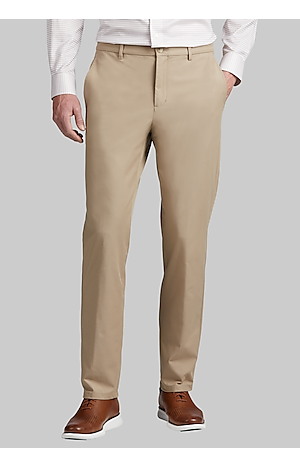
Hem length does most of the heavy lifting. The trouser should break just at or slightly above the top of the shoe. Too long and the fabric pools over the sneaker and hides the line that makes it look sharp; too short and it tips into something more self-conscious than most offices want. Our smart casual guide covers how the rest of the outfit should sit around it, and the guide to wearing a blazer casually is worth reading alongside it.
Keep the jacket soft. A structured suit jacket with heavy canvas and padded shoulders fights a sneaker, because the two halves of the outfit are making opposite arguments. A hopsack or cotton sport coat with light construction sits much better.
Where They Still Do Not Belong
There are rooms that will not take them. Anything with a stated dress code above business casual, client pitches at conservative firms, funerals, and formal evening events all call for leather soles. A sneaker with a dark suit reads as a deliberate statement rather than a safe choice, and at a client meeting or a wedding that is not the risk to take.
The honest test is whether your sneaker is the most casual thing in the room. If it is, and the room is a formal one, wear a loafer or a lace-up instead. Our guide to loafers covers the slip-on that fills exactly this gap, dressier than a sneaker and easier than an oxford.

Keeping Them Office-Ready
A white leather sneaker looks excellent for about three weeks and then looks neglected, which is the entire argument for maintaining them. In an office that distinction matters more than the shoe itself: a scuffed pair undoes the outfit faster than a slightly too-casual silhouette ever would.

Wipe the uppers with a damp cloth and a little mild soap when they pick up marks, and clean the rubber midsole separately with a melamine sponge, which lifts scuffs that cloth will not. Treat suede with a rubber brush and a protective spray before the first wear rather than after the first stain. Keep leather pairs out of the washing machine, which separates glued soles and warps the counter.
One clean leather low top in white or grey covers most of what an office asks for, and a suede pair in tan or grey covers the colder half of the year. Browse the men’s sneakers range to see how the silhouettes compare, and if you are pairing them with cotton trousers, our breakdown of chinos and khakis explains which fabric sits better against a sneaker.
