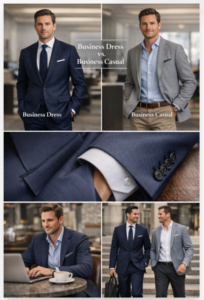
 Business casual for men is one of the most misunderstood dress codes in modern workwear, and that confusion is not accidental. The term sits between smart casual below it and business professional above it, leaving a wide range of interpretation in the middle. This guide cuts through all of that. You will know exactly what business casual means, which pieces belong in the rotation, what does not belong, and how to tell it apart from the dress code above it.
What Is Business Casual?
Business casual is a dress code that expects a structured, professional appearance without requiring a matched suit. The clearest way to understand it is by what it is not: it is not a full suit with a tie (that is business professional), and it is not a clean pair of chinos with a polo shirt (that is smart casual). Business casual lives in the space between those two.
The jacket is the dividing line. In most business casual environments, a structured outer layer, whether a sport coat or a blazer, is expected or strongly implied. Remove the jacket and you cross into smart casual territory. Add a matched suit with a tie and you are overdressed for the room.
The dress code gained traction in the 1990s as companies began relaxing their Friday policies, and it has since become the default for a wide range of industries: consulting, finance, legal support roles, account management, real estate, and any client-facing position that does not require formal courtroom attire.
The core formula is straightforward. A sport coat or blazer paired with dress pants and a collared, button-front shirt. That combination works for 90 percent of business casual situations.
The Three Outfit Formulas That Cover Everything
Business casual is not a single outfit. It is a range, and different offices sit at different points on that range. These three formulas cover the full spectrum from conservative to relaxed.
Formula 1: Sport Coat and Dress Pants
This is the most versatile combination in the dress code and the one that reads most clearly as business casual in any setting. A sport coat in navy, charcoal, or grey pairs with dress pants in a complementary tone. A white or blue button-down dress shirt, leather oxford shoes, and a pocket square if the environment warrants it. Tie optional.
This formula works for a law firm casual Friday, a finance office team meeting, a job interview at a mid-size company, and most client lunches. When in doubt about the environment, start here.
Formula 2: Blazer and Chinos
A step down in formality from Formula 1, but still solidly within business casual when executed correctly. A blazer in navy or charcoal paired with chinos in khaki, olive, or grey. The key is fit: slim or tailored cut chinos read professional; relaxed-fit chinos read weekend. The shirt stays collared and button-front. Loafers or clean leather dress shoes complete the look.
This formula suits creative agencies, tech offices with a business casual policy, and in-office days at companies where suits are rarely seen.
Formula 3: Dress Shirt and Dress Pants, No Jacket
The minimum expression of the dress code. A well-fitted, collared dress shirt tucked into dress pants, with leather shoes. This works in offices where business casual is relaxed by convention, not just policy, and where no client-facing obligations exist that day. It does not work for interviews, client presentations, or any setting where the dress code leans toward the formal end.
A polo shirt does not substitute for a dress shirt in this formula. Polo shirts sit in smart casual territory regardless of how well they fit or how premium the brand.
Business Casual Essentials: The Wardrobe Checklist
You do not need to build this wardrobe all at once. Start with one jacket, two pairs of pants, and three shirts. Those nine combinations will cover the week. Add shoes and accessories from there.
- Sport coat or blazer. One is enough to start. Navy is the most versatile color in the dress code. A sport coat in a neutral tone rotates with nearly everything in your closet. Wool or wool-blend fabric handles year-round wear; linen or cotton for warmer months.
- Dress pants. Two pairs minimum: one in charcoal or dark grey, one in navy or medium grey. Dress pants in a flat-front, tailored cut work with both Formula 1 and Formula 3. Avoid pleated fronts unless the office is conservative and the fit is deliberate.
- Dress shirts. Three to five shirts gives you full-week coverage. White and blue are the non-negotiable basics. A light stripe or subtle check adds variety without risk. Wrinkle-resistant fabric, like the Traveler Collection, is worth the investment if you commute. Shop dress shirts by fit: slim, tailored, or traditional depending on your build.
- Chinos. One pair in khaki or stone completes Formula 2. Chinos in a tailored or slim cut photograph as more professional than relaxed or straight cuts. Press them or choose a wrinkle-resistant option.
- Dress shoes. Oxford or derby shoes in dark brown or black cover the full range of business casual occasions. Cap-toe and plain-toe styles are the most office-appropriate. Browse dress shoes and lean toward leather with a rubber-blend sole for all-day comfort. For guidance on which style works where, see Selecting the Right Dress Shoe.
- Belt. Leather, matching the shoes in tone. No novelty buckles. The detail is small but visible in every meeting.
For fit benchmarks by category, see the dress shirts fit guide and signs that a blazer fits you well.
What Business Casual Is Not
The dress code has a wide lane, but there are clear boundaries. These items fall outside it regardless of how they are styled.
- Jeans. Even dark-wash, well-fitted jeans. Jeans are smart casual at best and read as off-duty in most business casual environments. The fabric signals leisure. Dress pants and chinos are the correct alternative.
- Sneakers. Including fashion sneakers and premium brands. The silhouette reads casual. Clean leather loafers or leather-soled boots are the correct alternative in environments that accept slightly relaxed footwear.
- T-shirts under a sport coat. A sport coat does not upgrade a t-shirt into business casual. The collared shirt is load-bearing. The jacket without a proper collar underneath signals that the wearer dressed backward.
- Polo shirts in client-facing settings. Polos work in smart casual and on some casual Fridays. In a client meeting or an interview, the collar reads too casual to anchor a business casual look.
- Ill-fitting clothes, regardless of price. A $400 dress shirt in the wrong size reads less professional than an $80 shirt that fits correctly. Fit is not an upgrade. It is the foundation. Free in-store alterations at Jos. A. Bank mean there is no reason to wear something that does not fit.
- Hoodies, athletic wear, and cargo pants. These are not business casual adjacent. They signal a deliberate departure from the dress code.
Business Casual vs. Business Professional
These two dress codes are frequently confused, and the stakes of getting it wrong are real. Showing up in business casual at a firm that expects business professional signals you did not research the culture. Showing up in a full suit at a business casual office is not a disaster, but it stands out.
Here is the practical difference.
Business Professional
A matched suit: jacket and trousers cut from the same cloth. A dress shirt with a necktie. Leather oxford shoes in black or dark brown. This is the standard at law firms, investment banks, accounting firms, and formal interview settings. Some industries still require this daily; others reserve it for client-facing days or formal presentations.
The matched suit is not optional in business professional. A sport coat and dress pants, even in the same color family, do not satisfy this dress code. The matching of the fabric is the signal.
Business Casual
A sport coat or blazer, not a matched suit jacket, paired with dress pants or chinos. A collared, button-front shirt. Tie optional. Leather shoes. The matched suit is replaced by separates. The tie is removed from the requirement.
The clearest test: is a matched suit expected, or is it optional? If expected, you are in business professional territory. If a sport coat handles it, you are in business casual. Also see Sport Coat vs. Blazer vs. Suit Jacket for a breakdown of how those three pieces differ.
The Industry Signal
Industry tells you more than the dress code description in most cases. Law, finance, government, and formal consulting: lean business professional until the office culture explicitly signals otherwise. Tech, creative, media, retail, real estate, and most modern offices: business casual is the upper register. When in doubt for an interview, dress one level above what you expect the office to wear daily.
For a full side-by-side breakdown, see Business Dress vs. Business Casual.
Business Casual by Occasion
The dress code shifts in formality depending on context. The same wardrobe pieces apply across all four scenarios below. The combinations change.
Job Interview
Default to the upper end of business casual: Formula 1, sport coat and dress pants, with a pressed white or blue dress shirt and leather oxfords. Research the company culture first. If the company is known for casual dress, a blazer and chinos still reads as appropriately serious for an interview without overdressing. Do not wear Formula 3 to an interview under any circumstances.
Office Day, No Client Meetings
Formula 2 or Formula 3 is acceptable depending on the office’s established culture. A blazer and chinos with a solid dress shirt covers most scenarios. If no one in your office wears a jacket on internal days, Formula 3 is fine. Observe what the people one level above you wear and match or slightly exceed it.
Client Meeting or Presentation
Formula 1. Sport coat, dress pants, pressed dress shirt. If the client is in finance, law, or government, add a tie. The principle: dress at least as formally as the client will be dressed, and ideally one step above.
Business Dinner or Networking Event
Formula 1 with more attention to accessories. A pocket square, a watch with a leather strap, dress shoes in excellent condition. The sport coat can be in a slightly more interesting fabric, a textured wool or a subtle pattern, while still reading professional.
Getting the Fit Right
Fit is not one of the variables in business casual. It is the variable. A poorly fitted jacket in the correct color still fails the dress code in any room where appearance is being evaluated. These fit checkpoints apply to every garment in the rotation.
- Sport coat and blazer. The shoulder seam sits at the edge of your shoulder, not past it. The jacket buttons without pulling. The sleeve shows about a half-inch of dress shirt cuff. The back lies flat with no pulling across the shoulder blades. See signs that a blazer fits you well for the full checklist.
- Dress shirt. The collar closes without gap and without choking. The sleeve ends at the wrist bone. The body should not balloon when tucked in and should not pull when you reach forward. A tailored or slim fit shirt achieves this for most builds without bespoke work. See the dress shirt fit guide for specifics.
- Dress pants. The waist closes without a belt doing structural work. The break at the ankle is slight or no-break for a modern, clean look. No bunching at the thighs, no pulling across the seat. See 4 ways to find dress pants that fit.
Jos. A. Bank offers free in-store alterations with purchase at 600-plus locations. If a garment fits in the shoulders and chest, alterations handle the rest. Use them.